Trading Bot vs. Holding - Which Actually Wins?
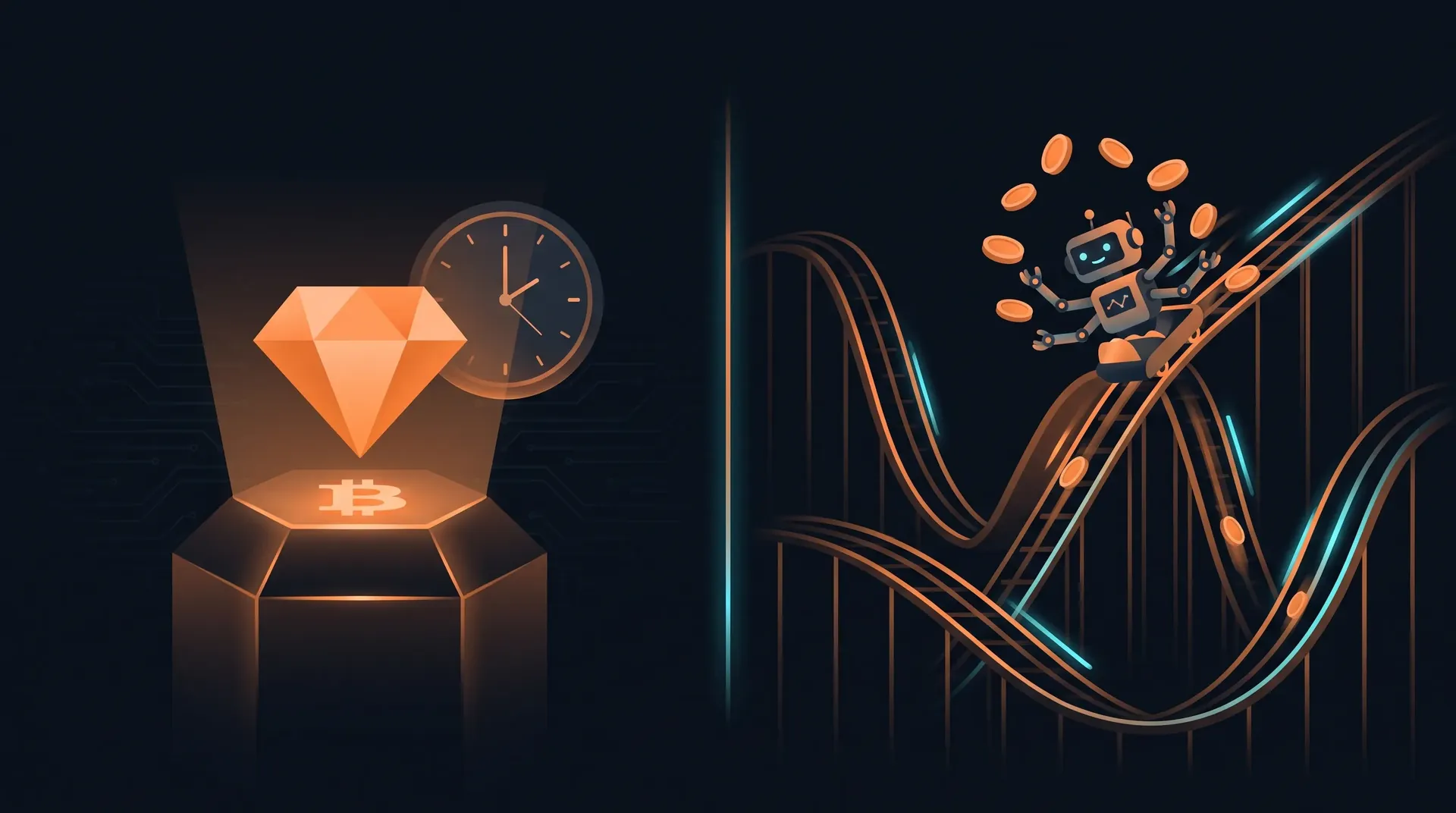
Short answer: It depends on the regime, and it flips more often than bot marketers admit. In ranging and choppy markets, documented grid runs beat holding by double-digit percentage points. In strong trends, holding wins - and most years contain both regimes, which is why position sizing matters more than the bot.
The most common real question about bots is also the most honest one: "why not just hold?" The answer depends on the market regime, and it flips more often than bot marketers admit. This guide lines up the documented numbers on both sides, per regime.
table of contents
What holding actually is
Stripped of crypto-forum baggage, buy and hold is a defined strategy: buy assets you expect to appreciate long-term, hold through volatility, do not sell after declines, and do not attempt market timing - selling to rebuy lower [1]. Its advocates span from Benjamin Graham to Warren Buffett and Jack Bogle [1].
Its structural advantages are real: buy and hold involves the fewest transactions for a given amount invested, so it pays the least in commissions, and long-term tax treatment is usually better than short-term trading's [1]. The behavioral evidence is also on its side: return-chasing - buying funds with high past returns, selling those with low - correlates with reduced profits, and short-term market returns are close to unpredictable [1].
Ranging markets: bots win, and it is documented
The cleanest community data point is a 111-day Pionex test through the slow 2022 bear market: a grid bot on BTC/ETH finished +1.14% while simply holding BTC over the same window ran -16.6% - a 17.7 percentage-point spread from volatility harvesting [2]. That is the scenario grid bots are built for, and where they genuinely beat holding: price oscillates, the bot converts each oscillation into a realized step, and the "boring" market becomes the productive one.
The grid guide covers the fee math that determines how much of that spread survives costs; the short version is that fee-drag on tight grids can eat most of it.
Trending markets: holding usually wins
In a clean uptrend, the failure is structural: the grid sells your inventory progressively as price rises and ends the move fully in cash, having "realized profit" on every step while missing the run above the range. In a downtrend, both approaches lose - the bot just loses less while accumulating a bag, which experienced operators summarize as "you still lose, just lose less."
Neither regime failure is a bug. It is the strategy: grid trades the range and concedes the trend. The honest comparison therefore tracks regime, not tool.
The fee drag compounds against the bot
Every grid round trip pays two fees, every DCA cycle pays spread, and subscription platforms add a fixed monthly layer on top. On thin edges the fee drag can consume most of gross profit - and unlike market outcomes, fees are the one input you control completely. The cost calculator compares your platform's all-in cost against your expected strategy yield; on small accounts the subscription often exceeds the edge.
A defensible middle ground
The structure that survives both regimes, assembled from the community evidence:
- Core holding in assets you would hold anyway - the buy-and-hold sleeve [1].
- Satellite bot allocation - grid or DCA - on the volatile portion only, capped so a total loss of the bot position would not hurt.
- Plain-DCA accumulation into the core on Graham's two-parameter schedule: fixed amount, fixed interval [3].
- Rebalance the bot sleeve on regime change, not on emotion; keep the core untouched by any of it.
The split also survives the psychology test: the core holding is boring by design, and boring survives drawdowns; the bot sleeve is interesting by design, and its interest is priced as entertainment with a possible positive expected value. Traders who invert the sizing - small boring core, large exciting bot sleeve - have rebuilt the casino with extra steps, and the regime table above says exactly when that structure pays and when it does not.
One warning from the tax side: bots multiply taxable events. A hundred grid round trips can mean a hundred disposals with basis calculations - the taxes and records guide explains why the records must exist from day one, because buy-and-hold's long-term treatment [1] quietly disappears the moment a bot is doing the selling.
FAQ
Do trading bots beat buy and hold?
In sideways and choppy markets, yes - the documented 111-day community test showed a grid bot up 1.14% against BTC down 16.6% [2], a 17.7-point spread. In strong trends, holding wins. Regime recognition beats tool choice.
How much capital does a bot need to make sense?
Enough that strategy profit meaningfully exceeds subscription cost: at $30/month, roughly $10k+ deployed in a strategy yielding 15-20% annualized just to cover the fee. Exchange-native free bots drop that bar to zero - the cost calculator does the arithmetic for your numbers.
Is holding really a strategy?
Yes - the oldest one. Buy and hold is deliberate passive management: no market timing, no selling after declines, confidence that value is higher in the future [1]. Its cost structure is the best in finance: fewest transactions, fewest taxable events, lowest fees.
Can I run both?
That is the defensible middle ground most experienced operators land on: a core holding plus a satellite bot allocation on the volatile portion, sized so a total loss of the bot bag would not hurt. You capture oscillation upside without betting the stack.
What does the research say about market timing?
It cuts against the timers: stock market returns are almost unpredictable in the short term, tend to revert to the long-term average, and return-chasing behavior - buying what went up, selling what went down - measurably reduces profit [1].
Sources
- Wikipedia - Buy and hold (position trading, market timing critique, return-chasing) - accessed 2026-09-06
- Reddit - BTC/ETH growth bot real results in a slow bear market vs holding (111-day test) - accessed 2026-09-03
- Wikipedia - Dollar cost averaging (Graham's two-parameter formulation) - accessed 2026-09-06