#1

Gunbot
Privacy-first desktop bot running locally on your machine, now on a single $29/month plan - the self-hosted sweet spot between Freqtrade's effort and cloud subscriptions.
Self-hosted US ok
Turn Pine Script alerts into orders - webhook execution done right.
Short answer: Gunbot is our top-rated TradingView bot as of 2026-10-18 (7.8/10), monthly subscription.
bots on this page: 11 · fully reviewed (active): 11 · free or with a free tier: 8 · need no third-party API keys: 4
quick picks
Privacy-first desktop bot running locally on your machine, now on a single $29/month plan - the self-hosted sweet spot between Freqtrade's effort and cloud subscriptions.

The easiest no-code entry into bot trading - if-this-then-that rules across crypto, on-chain and even stocks, with a real free tier.
Veteran cloud platform with a genuine free tier, AI strategy designer and the broadest copy-bot marketplace.
16 free built-in bots inside the exchange itself - zero subscription and no third-party API keys, at 0.05% per side.

The TradingView-signal specialist: real free tier, 30-50% lifetime affiliate program and free Premium tools when trading on Hyperliquid.

Terminal-plus-bots for active traders - strong scanners, 5-day no-card trial and a real 30-day refund window.
The most established cloud bot platform - deep features, real API-key incident history, now OAuth-hardened.

Veteran platform with the deepest scripting (HaasScript) and a rare self-hosted TradeServer lane - power users only.

Free grid and DCA bots inside Binance Trading Bots - no third-party API keys, you pay only trading fees.

Free grid and DCA bots inside OKX Trading Bots - no third-party API keys, you pay only trading fees.
Beginner-focused cloud platform for grid/DCA - pricing unverifiable from here, so treat plan details as indicative.
| Bot | Type | Price | TradingView | Free tier | Trial | Backtest | Paper | Exchanges |
|---|---|---|---|---|---|---|---|---|
| Gunbot | Self-hosted | $29/mo | yes | - | - | yes | yes | 20 |
| Coinrule | Cloud platform | 0.02% of volume | yes | yes | - | - | - | 20 |
| Cryptohopper | Cloud platform | $29-129/mo | yes | yes | 3 days, no card | yes | yes | 16 |
| Pionex | Exchange-native | 0.05% per trade | yes | yes | - | - | - | - |
| WunderTrading | Cloud platform | $0-100/mo | yes | yes | 7 days, no card | - | yes | 18 |
| Altrady | Cloud platform | $30-97/mo | yes | yes | 5 days, no card | yes | yes | 17 |
| 3Commas | Cloud platform | $15-140/mo | yes | - | 3 days, no card | yes | yes | 9 |
| HaasOnline | Cloud platform | $19.99-249.99/mo | yes | - | 7 days, no card | yes | yes | 24 |
| Binance Trading Bots | Exchange-native | free | yes | yes | - | - | - | - |
| OKX Trading Bots | Exchange-native | free | yes | yes | - | - | - | - |
| TradeSanta | Cloud platform | $14-70/mo | yes | yes | 14 days, no card | - | - | 8 |
Live values from our database - details and caveats in each review. "-" = not documented.
Every platform in this table automates the same relay: your Pine Script logic never leaves TradingView; what crosses the internet is an alert. That makes the pipeline's weakest hop the actual product. A platform that logs every webhook with a timestamp, parses idempotently, and shows per-alert order status turns silent failure into visible failure - the difference matters more than any strategy marketplace.
TradingView's own documentation is the source of truth for the alert side: webhook payloads, plan-gated frequencies, and the bar-state rules that decide whether your indicator repainted[6]. The exchange side is documented by the venues' API rate limits and 429 semantics[7]. The platform in the middle is what you are paying for - audit it as middleware, not magic.
Native Pine execution: 3Commas runs Pine Script strategies directly and prices from $15/mo annual to $105/mo Expert[1]. The established option, with the incident history (2022 key leak) that makes the key security guide non-negotiable.
Free-tier entry: WunderTrading's free tier (one bot of each type, webhooks included) is the most usable zero-commitment start[2]; Cryptohopper's Pioneer tier allows 80 positions at a 10-minute minimum interval[3] - fine for slow signals, throttled for anything active.
Volume-fee pricing: Coinrule bills 0.02% of volume instead of a subscription[5] - at $10k monthly turnover that is $2/mo, cheaper than every flat plan; at scale it crosses over. Altrady (EUR 28-90/mo) sits in the middle with a 30-day refund window[4].
All of them require exchange API keys - that is the lane's structural custody trade, and the reason the no-API-key alternatives exist for grid/DCA-shaped strategies that do not need external signals.
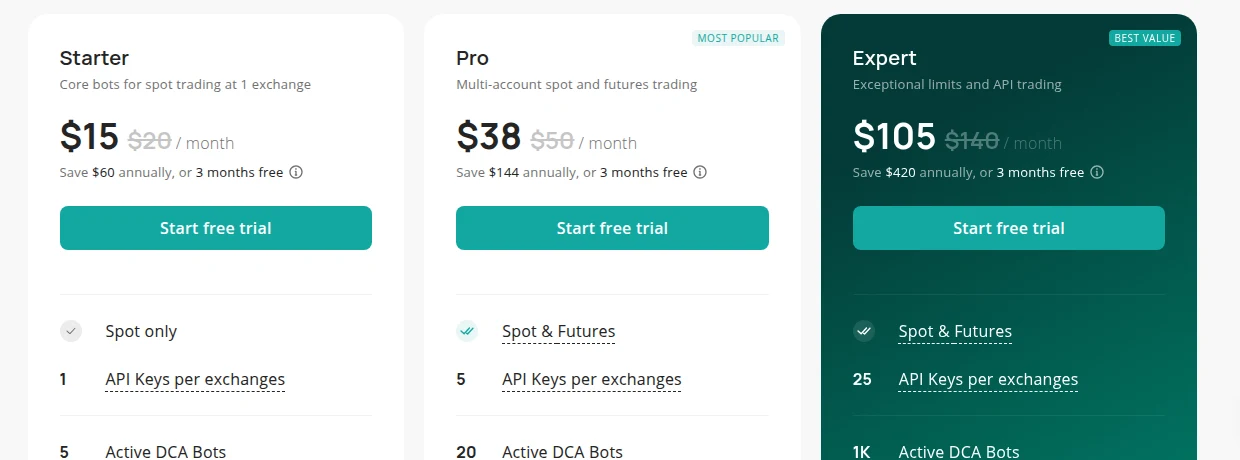
The plan landscape on this page spans three pricing models, and the honest comparison depends on your alert frequency. Flat subscriptions (3Commas $15-105/mo annual[1], Altrady EUR 28-90[4], Cryptohopper $29-129/mo on paid tiers[3]) predict costs but gate webhook features by plan. Free tiers (WunderTrading one bot per type[2], Cryptohopper Pioneer at 10-minute intervals[3]) carry real limits that reshape strategy design. Volume fees (Coinrule 0.02%[5]) start cheaper than everything and cross over at scale - the crossover point is computable, not a matter of taste, and the bot cost calculator draws it for your numbers.
Feature gating is where vendors differentiate quietly: backtesting, trailing TP handling, and multi-bot routing shift between plans between quarters - our reviews carry dated plan tables precisely because this page's vendors repriced repeatedly in 2025-26[1][3][4].
The webhook JSON is a contract you write and the platform interprets - most silent failures live there. Conventions that survive production: a stable action vocabulary (buy/sell/close) the platform maps explicitly; the bot or strategy identifier in every payload so routing never guesses; quantity as explicit text (not computed floats with locale commas); and a client order ID you generate for idempotency. TradingView's alert templating supports all of this[6]; the platforms differ in which fields they honor and how they treat unknowns - which is why the first payload you send to any new platform should be a deliberately malformed one, watched in the logs.
The same discipline applies to alert volume: a strategy that fires on every bar close needs plan-gated frequency headroom[6] and a platform that queues rather than drops. Both facts are testable in a trial week; neither appears on a pricing page.
This lane cannot avoid API keys - the platform must place orders as you, which means a trade-only key copy lives on vendor infrastructure for every platform in the table. That is the structural difference from the exchange-native and wallet lanes, and it should be priced into any decision between them: the 2022 3Commas leak drained accounts through exactly this chain[7], with trade-only keys, without withdrawal permissions. The mitigations are real (IP binding as venues like OKX document it, one key per service, small balances) and they are in the key security playbook - but they reduce, not remove.
So the honest decision rule for this lane: use it when external signals are the actual edge you are automating - a Pine strategy you have validated across regimes, not a marketplace pack. If your strategy is grid/DCA-shaped and mechanical, the no-key lanes execute the same ideas cheaper and with less custody surface. Signal automation is a tool for a specific job; this page exists so the job, not the marketing, makes the choice.
Your Pine Script fires an alert; TradingView sends a webhook (JSON payload) to the platform's endpoint; the platform parses it into an order with your preconfigured position sizing, DCA and stop rules, then places it via exchange API keys. Pine strategies can execute natively on 3Commas; others translate strategy alerts via webhooks.
The one that logs every incoming alert, retries failed deliveries, and exposes per-alert order status. WunderTrading, 3Commas and Altrady all document webhook support; the differentiator is operational (logging, idempotency), not the marketing page. Test with a deliberately broken payload before trusting real funds.
3Commas executes Pine strategies natively[1]. Elsewhere, alert-to-webhook translation is the path - which also means alert frequency limits and payload size limits from TradingView's side apply[6].
Sub-second to a few seconds in normal conditions: webhook delivery, platform parsing, exchange API round trip. Latency spikes exactly when markets are stressed - the honest assumption is that your fill price differs from the alert price, and position sizing should tolerate that.
An indicator that changes historical values after the bar closes. Alerts fire on live bars, so a repainting script sends different signals than its backtest showed. Pine's bar-state rules are documented by TradingView[6] - pin them, and treat any strategy whose backtest outperforms its alerts as repainted.
Yes - the platform places orders with your keys, so the [API key security guide](/guides/api-key-security/) applies in full: trade-only scope, IP whitelisting where offered, one key per service. The 3Commas 2022 leak is the standing incident for this lane.
Subscriptions from $0 (WunderTrading free tier, one bot per type[2]) through Cryptohopper's free Pioneer tier (80 positions, 15 coins, 10-minute interval[3]) to $105/mo 3Commas Expert[1]. Coinrule bills 0.02% of volume instead[5] - cheap at low turnover.
Most platforms route alerts to bots by payload identifiers (bot ID fields in the webhook JSON). One bot per alert strategy is cleaner to audit; many-alert setups need disciplined payload templates and logging.
No alerts, no trades - the bot is a pass-through, not a manager. Platforms cannot fix upstream silence. If your strategy needs execution during exchange stress, pair signals with on-bot logic (stops live on the exchange, not in the alert stream).
Wherever the platform holds API support - the big cloud platforms cover 8-20+ venues each (3Commas, WunderTrading, Altrady[4]). Exchange-native bots rarely accept external webhooks, which is the structural limit of the no-key lane.
Point alerts at the platform's paper-trading or test endpoint (WunderTrading and 3Commas both offer paper trading), send deliberately malformed payloads, watch the logs. A pipeline you have not broken on purpose is untested.