#1

Freqtrade
The reference open-source bot: free, auditable, keys never leave your machine - at the cost of Python skills and patience.
Self-hosted Open source Free tier US ok
Code you can read, audit and modify - community-tested for years.
Short answer: Freqtrade is our top-rated open-source bot as of 2026-10-18 (8.1/10), free.
bots on this page: 6 · fully reviewed (active): 6 · free or with a free tier: 6 · need no third-party API keys: 6
quick picks
The reference open-source bot: free, auditable, keys never leave your machine - at the cost of Python skills and patience.

The open-source market-making framework - community-owned, 318 connectors, and the only bot line with institutional-grade pedigree.

The quant's choice: MIT-licensed research framework where backtesting is free forever and lifetime licenses unlock live trading - clean model, serious tooling.

Open-source Python bot with web UI and plugin ecosystem - the friendliest on-ramp into self-hosted bot trading.

The most ambitious open-source project in the niche: visual strategy design, data pipelines and a token economy - steep curve, zero cost, no data collection.

Public-domain (Unlicense) grid/martingale futures bot for Bybit, OKX, Binance, Bitget and Hyperliquid - raw power for developers, invisible for everyone else.
| Bot | Type | Open source | Backtest | Paper | Custom code | Exchanges | Price | US |
|---|---|---|---|---|---|---|---|---|
| Freqtrade | Self-hosted | yes | yes | yes | yes | 11 | free | US |
| Hummingbot | Self-hosted | yes | yes | yes | yes | 50 | free | US |
| Jesse | Self-hosted | yes | yes | yes | yes | 12 | $0-1599/mo | US |
| OctoBot | Self-hosted | yes | yes | yes | yes | 12 | $0-29.99/mo | US |
| Superalgos | Self-hosted | yes | yes | yes | yes | 15 | free | US |
| Passivbot | Self-hosted | yes | yes | yes | yes | 8 | free | US |
Live values from our database - details and caveats in each review. "-" = not documented.
Feature matrices go stale the day a vendor edits them; repository activity cannot be faked. Our 2026-10-21 GitHub API snapshot of the six open-source bots we track - 6 frameworks, all with 6 public code - reads like this:
The pattern is consistent across years: Freqtrade and Hummingbot behave like funded vendors - monthly-ish releases, issue triage, migration notes[1][2]. Passivbot is a lean single-maintainer project with public-domain licensing that nonetheless pushes constantly[6]. Jesse iterates on master without tagged releases[3], OctoBot ships betas on schedule[4], and Superalgos - pushed recently but with a November 2024 tag - sits in the warning zone where recent commits no longer guarantee packaged, tested releases[5].
Repo health also prices the real cost of "free": every framework here needs the ops layer from our self-hosted lane and a venue fee schedule that dwarfs licensing questions - the median entry price across subscription platforms, n/a/mo, is what "free" is usually compared against, and the comparison is volume-dependent by nature[1][2].
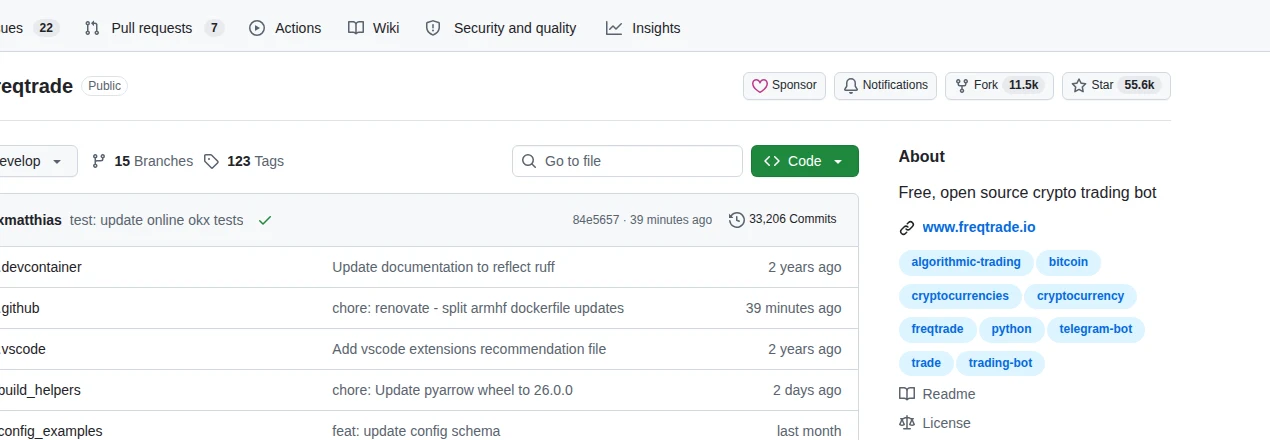
Reading the code lets you verify three properties vendors cannot sell: no key exfiltration (every network call is inspectable), order semantics (how retries, partial fills and rate-limit backoffs actually behave - Freqtrade documents this instead of hiding it[7]), and cost model truth (fees are whatever the exchange charges - the same schedule a paid platform hides behind its subscription). It cannot verify strategy profitability, and it will not stop you from overfitting your own backtests.
The ecosystem point matters for longevity: most of these frameworks sit on CCXT's unified exchange API, so exchange-side breaking changes get patched once in the library and inherited by everyone upstream. When you evaluate a smaller OSS bot not on this page, its first question should be: does it ride CCXT or maintain its own connectors?
Strategy development, general trading: Freqtrade. Python, backtesting, dry-run, hyperparameter optimization, the largest community - the default for a reason[1][7].
Market making and multi-venue presence: Hummingbot. 318 connectors, maker-focused strategy templates, institutional-grade activity[2][8]. Heavier than you need for simple grid/DCA.
Futures parameter research: Passivbot. Futures-native optimization across grid/DCA parameter sets, public-domain code, active development[6]. The math-first interface repels beginners - by design.
Research-grade backtesting: Jesse. MIT, clean statistics API, no tagged releases (master-only)[3]. Use it as a research instrument, not a production daemon.
Visual strategy building: OctoBot (web UI over an open core[4]) and Superalgos (node-based editor[5]). Both trade CLI simplicity for interface comfort; check their repo health before committing long-running capital.
The r/algotrading comparison threads repeat one conclusion every year: public strategies underperform, and the community exists to help you build your own - not to hand you an edge[9].
The funding model predicts the roadmap. Hummingbot runs on foundation sponsorship - releases and connector work track sponsor priorities[2][8]. OctoBot sells managed cloud hosting of its free core, so the open-source version is also the funnel[11]. Jesse sells pro licenses on top of the MIT core[10]. Passivbot is donation-funded and public-domain - the purest community model, and the most dependent on one maintainer's continued interest[6]. Superalgos uses a token incentive model - contributors are paid in the project's own currency, which aligns contributors with the token's health as much as with the software's[5][9].
Read your framework's model before depending on it: the release cadence in the figure above is the output of these incentives, not a coincidence. GPL copyleft (Freqtrade, OctoBot) also means your modifications stay open if you distribute - irrelevant for personal trading, decisive if you build a service on a fork.
git describe belongs in your monitoring dashboard.Before committing capital to any framework on this page - or any OSS bot not on it - five questions with objective answers: when was the last commit (not the last star)? When was the last tagged release, and does the project tag at all? Is the issue backlog growing faster than it closes? How many contributors merged in the last quarter? And does the project publish a changelog with migration notes, or raw diffs? Every one of these is visible in the repositories this page cites[1][2][3][4][5][6], and together they predict how the next exchange API break goes for you.
The same diligence applies to your own deployment: pin the version you audited, watch the project's release feed, and schedule updates as deliberately as you schedule strategy changes. Open source gives you the right to know - the responsibility to look comes with it.
Finally, a note on what these frameworks share underneath: most sit on CCXT's unified API layer, so connector fixes propagate library-wide and no single project maintains every exchange alone. That shared infrastructure is why the lane survives exchange churn at all - and why an OSS bot that rolls its own connectors deserves extra scrutiny on every health question above.
Different, not better: maximum control, auditability and zero subscription cost against real setup and strategy effort. The recurring community verdict is that public strategies underperform live - your edge has to be yours either way.
By our 2026-10-21 GitHub API snapshot: Freqtrade pushed 2026-10-20 and released 2026.9 in September; Hummingbot released v2.17.0 in September; Passivbot pushed the day we checked. All three are maintained at vendor speed.
GPL-3.0 (Freqtrade, OctoBot) is copyleft - fine for personal use, restrictive if you fork into a closed product. Apache-2.0 (Hummingbot, Superalgos) and MIT (Jesse) are permissive. Unlicense (Passivbot) is public domain. For personal trading, the practical difference is small; for building a business on a fork, it is decisive.
Three things: you can verify no key exfiltration exists, you can read exactly how orders are placed and retried, and you can fix or extend behavior without waiting for a vendor. It does not buy strategy quality - that remains your problem.
Not dead - its repository was pushed 2026-10-15 - but the release cadence has stalled relative to peers. For a framework whose value is its visual strategy builder, that gap matters: weigh it against the active ones unless you specifically need its model.
Four checks: last commit date (maintenance alive), last release date (packaged changes), open-issue trend (growing backlog = rotting), and contributor count beyond one person (bus factor). Stars are popularity, not health - our figure ranks by what actually predicts fixes.
Yes - that is the point. Freqtrade's stated minimum is 2GB RAM / 1GB disk / 2 vCPU; any $5-20 VPS exceeds it. The [self-hosted lane](/best/self-hosted/) covers the ops bill in detail.
Freqtrade, Hummingbot (perpetual connectors) and Passivbot (futures-native) all do. Leverage changes the risk profile - funding and liquidation apply before any code quality question; the [futures lane](/best/futures/) quantifies that.
As references, yes; as money-handling systems, no. Backtests of public strategies are typically overfit or regime-specific. Treat them as syntax examples for writing your own, validated across regimes you did not download from.
Variously: Hummingbot operates a foundation with sponsorships; OctoBot sells managed cloud hosting of its free core; Jesse sells pro licenses; Passivbot accepts donations; Superalgos uses a token incentive model. The model explains the release cadence - follow the money when predicting the roadmap.
The connector layer - which for most of these frameworks is CCXT or their own connector code. Active repos patch within days; stalled ones bleed users to 429s and silent failures. This is the practical reason repo health outranks every feature comparison.