Lifetime licenses
The one-time-license model is vanishing: our last listed vendor (Gunbot) now sells a subscription only. This hub stays up as an explainer.
No bots match this filter yet - check the full table.
The model that priced maintenance out of existence
(no bots match right now - see the full comparison table.)
A trading bot is not a product you buy once - it is a maintenance contract with the world's fastest-moving exchange APIs. Lifetime pricing sold that contract as a one-time sale; the market has now priced it correctly. The sequence that ended the model, documented in our fact-checks:
- Gunbot - the last major vendor selling lifetime licenses - retired them and moved to a $29/month subscription; existing licenses remain valid for holders[1].
- HaasOnline sells cloud plans at $19.99-249.99/month (cheaper billed yearly or in BTC) with no lifetime tier[2].
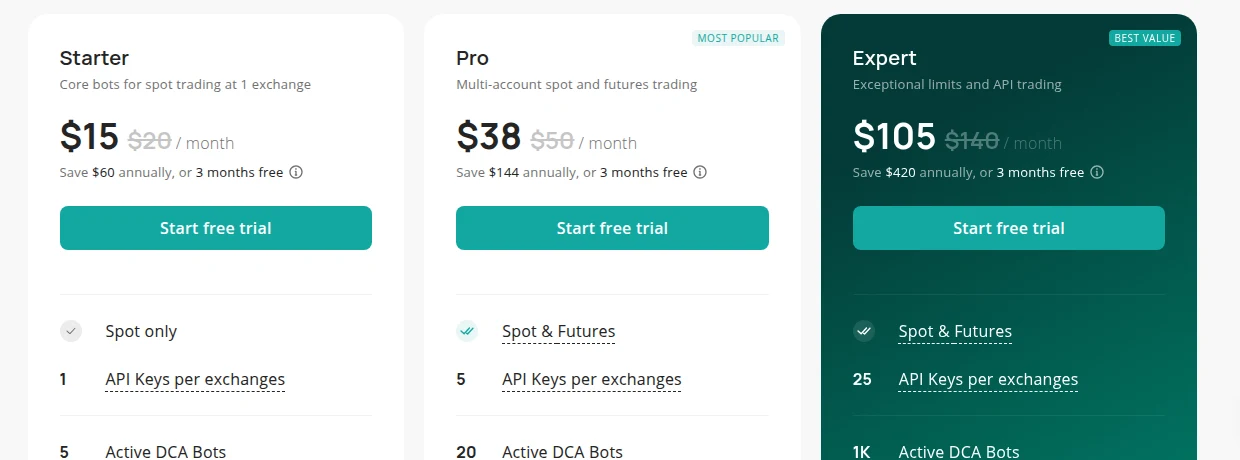
- The subscription baseline across cloud platforms: 3Commas $15-105/mo annual[3], Bitsgap $23-149/mo, Cryptohopper $29-129/mo.
The figure's second line is the real cost curve. A subscription's flat line is a revenue stream that funds connector maintenance; a lifetime price is a payment history that ends. Every API break after the last purchase is funded by goodwill - and the 2025-26 period alone saw multiple breaking venue changes.
What existing holders should know
Your license is an asset with a decay rate, not a permanent win. Gunbot's statement that existing licenses remain valid[1] is the good case. The decay comes from exchange-side change: a license on a stalled build loses venues one API deprecation at a time. Practical holder rules: pin the version that works, watch the changelog, and value the license at roughly one year of replacement subscription (our figure) declining from there.
Do not let the sunk cost pick your stack. A held license is only worth using while its maintenance is real. If the vendor's cadence slips, the free-software route - Freqtrade at $0, maintained weekly[6] - plus a $5-20 VPS[5] out-features a frozen lifetime build within a year.
The pricing landscape the model left behind
0 platforms still match this page's lifetime filter in our tracking - effectively the held licenses, because 0-style free alternatives cover the functional ground differently. The current market offers three pricing models, all visible on this site: subscriptions ($14-149/mo across the cloud lanes[1][2][3]), volume and per-trade fees (Coinrule 0.02%, the sniper lane's 0.7-1%), and free software with an ops bill (Freqtrade plus a $4.54+/mo VPS[5][6]). The lifetime model was a fourth option; its extinction is a data point about what bot maintenance costs, not a pricing footnote.
The bot cost calculator prices the remaining models against your volume - which is the comparison the lifetime era never had to make, and the reason its disappearance is mostly a good thing for buyers.
Freemium deserves its own line in that comparison: Cryptohopper's free Pioneer tier (80 positions, 15 coins, 10-minute interval) shows how far a $0 entry now reaches[7]. The lifetime pitch once bought "freedom from subscriptions"; the market responded with free tiers, free software, and subscriptions that price maintenance honestly. Every model except the lifetime one now has a no-upfront-payment entry point - the buyer's leverage improved after the model died.
The mortality statistics behind the break-even
Our dead-platform tracking puts 2 platforms in the graveyard and 0 on the watch list - vendor mortality in this market is not a theoretical risk but the base rate. A lifetime purchase is an unsecured loan to the vendor, repaid in software updates. The 10.3-month break-even in our figure assumes the vendor keeps maintaining at least that long; the graveyard odds say discount everything beyond the first year. That is the arithmetic conclusion of the model's extinction: the subscription model did not win on price, it won on survival odds - and a surviving vendor at $29/mo[1] beats a buried one at any price.
For holders doing the final accounting, the checklist is short: confirm the vendor still ships changelog entries for your version[1]; confirm the exchanges you actually use still work on your build; and compute the remaining value as (months until your next forced upgrade) times $29 - minus the valuation you place on never filing a support ticket again. Holders in that positive-value zone should simply keep what they have; holders below it should migrate before the choice is made for them by an API deprecation. And if the migration day comes, the open-source hub rates the frameworks you would inherit - including how their maintenance cadence compares to the vendor you just left.
The pricing models that replaced it, compared
Three models now divide what lifetime pricing once bundled, and each prices a different truth. Subscriptions ($29/mo Gunbot[1], $19.99-249.99/mo HaasOnline[2], $15-105/mo 3Commas[3]) price ongoing maintenance honestly - and shift vendor-survival risk to the vendor, which is why they won. Volume and per-trade fees (Coinrule's 0.02%, the sniper lane's 0.7-1%) price usage - attractive at low activity, regressive at scale. Free software with an ops bill (Freqtrade plus a $4.54+/mo VPS[5][6]) prices your time instead of money - the model for readers with the skills.
The buyer's leverage improved across the board after the lifetime model died: every lane now has a no-upfront-payment entry (free tiers[7], OSS, trials), so any new lifetime-style offer competes against "start free, upgrade when a named feature earns it". That competition is structural, not promotional - it is why reintroducing lifetime pricing would be a step backward for buyers - and why this page would treat such a move as a signal worth investigating, pricing it against the mortality table above, rather than celebrating. The market already voted; this page just records the result. That is a buyer's market for automation - and the historical reason it exists is that enough buyers pre-paid enough dead licenses to fund the alternatives.
Warnings
- Any vendor reintroducing lifetime pricing is asking you to prepay their survival risk. Judge it with the break-even and mortality math above, and the FTC's marker for anything pitched with returns attached[7].
- Held licenses: verify changelog activity before trusting venue coverage. Valid does not mean maintained - an unpatched build is an orphaned bot with your keys.
- Small-vendor lifetime offers concentrate every risk on this page: unpublished maintenance history, thin teams, no secondary market. The discount is the compensation for all three.
- Trading fees are identical under every model - 0.1%-class per fill at major venues[4]. A "lifetime free trading" claim confuses software licensing with venue fees; the venues still charge.
- This hub is a market monitor, not a ranking. With zero bots matching the filter, the cards are empty by design - the math above is the content, and it updates as vendors do.
- Related pricing reads: the free lane covers the no-upfront models, the self-hosted lane prices the ops bill, and the open-source hub rates the maintenance health of the free route[6].
// Sources
- Gunbot homepage + pricing - live fetch 2026-10-18 (HTTP 200): subscription plans, lifetime licenses no longer sold, existing ones remain valid - accessed 2026-10-18
- HaasOnline pricing page - live fetch 2026-10-21 (HTTP 200): cloud plans $19.99-249.99/month (cheaper billed yearly or in BTC) - no lifetime tier - accessed 2026-10-21
- 3Commas pricing page - the subscription baseline: $15/38/105/mo annual (verified headful 2026-10-18, screenshot in our DCA guide) - accessed 2026-10-18
- Binance fee schedule - trading fees identical under every pricing model (verified headful 2026-10-18, screenshot in our grid guide) - accessed 2026-10-18
- OVH VPS pricing - self-hosting alternative from $4.54/month (2 vCores, 4GB RAM) (verified live 2026-10-18) - accessed 2026-10-18
- Freqtrade repository - the free-software alternative to the whole pricing question, GPL-3.0, actively maintained (verified 2026-10-21) - accessed 2026-10-21
- Cryptohopper pricing page - the freemium counter-model: Pioneer free (80 positions, 15 coins) upward (fetched 2026-09-03) - accessed 2026-09-03
- FTC - What To Know About Cryptocurrency Scams (last successful fetch 2026-09-03, datacenter re-fetch 404s) - accessed 2026-09-03
// FAQ
Are lifetime licenses worth it?
If you already hold one and the vendor maintains it: yes, nothing to change. For new buyers, the model has effectively ended - Gunbot, the last major vendor selling lifetime licenses, retired them for a $29/month plan[1]. The license is a bet on the vendor's continued existence, and the market has priced that bet out of the market entirely.
Why did vendors stop selling lifetime licenses?
Maintenance is the product. Exchange APIs change constantly; a one-time price sold ongoing work at a loss. Subscriptions (Gunbot $29/mo[1], HaasOnline $19.99-249.99/mo[2], 3Commas $15-105/mo[3]) match revenue to the cost of staying alive - which is also why subscription vendors' survival odds are better.
Do existing lifetime licenses still include updates?
Gunbot states existing lifetime licenses remain valid for their holders[1] - the vendor honors what it sold. HaasOnline's lifetime options are gone from current pricing entirely[2]. The distinction that matters: valid is not the same as maintained - check the changelog before assuming.
What is my existing lifetime license worth?
Its replacement cost minus the risk: $299 once versus $348/yr at Gunbot's current $29/mo breaks even in ~10.3 months (our figure) - so a held license is worth roughly a year of subscription fees, provided the vendor keeps shipping. The residual value decays with every missed API change.
Is the subscription model better for buyers?
It trades upfront cost for survival odds. $29/mo is $348/yr - more than $299/once after ten months - but the vendor's revenue keeps funding exchange API maintenance, which is what actually protects your positions. A dead vendor's free lifetime license protects nothing.
What happened to lifetime-license vendors historically?
The pattern repeats: one-time-license products either retire the model (Gunbot), collapse with the license (various smaller tools over the years - our dead-platform tracking counts them), or pivot to subscriptions (HaasOnline's cloud tiers[2]). The license outlives the company only when the company outlives the maintenance cost.
Can I still buy any lifetime-license bot?
Small vendors occasionally offer them - which concentrates the risk: less-published maintenance history, thinner teams. Our tracking shows no major vendor selling lifetime licenses as of October 2026. Scrutinize any current offer against the break-even and mortality math on this page.
Is the free-software route the better lifetime play?
Arguably yes: Freqtrade is GPL, free, and maintained at vendor speed[6] - the "lifetime license" that renews itself by community. You pay the [self-hosted ops bill](/best/self-hosted/) instead of a subscription, and that is the honest comparison the lifetime model always obscured.
Do lifetime licenses hold their value on resale?
There is no meaningful secondary market - licenses are typically non-transferable, and a transferable license from a shrinking product has thin demand. Assume zero resale value when computing the break-even.
How do I compare a lifetime offer against this page's math?
Three numbers: the subscription alternative (Gunbot $29/mo[1], HaasOnline $19.99-249.99/mo[2], 3Commas $15-105/mo[3]), the break-even months (price divided by monthly fee), and your honest estimate of the vendor's remaining maintenance years. If the third number is smaller than the second, the lifetime price is not a deal.
If the model is dead, why does this page still exist?
Because search demand persists and existing holders need current answers: what their license is still worth, what the vendors now sell, and what the honest alternatives cost. This page stays as an explainer and monitor - if a vendor reintroduces lifetime pricing, our tracking will document it.