#1

Freqtrade
The reference open-source bot: free, auditable, keys never leave your machine - at the cost of Python skills and patience.
Self-hosted Open source Free tier US ok
Dollar-cost averaging automated - with safety orders that need honest capital math.
Short answer: Freqtrade is our top-rated DCA bot as of 2026-10-18 (8.1/10), free.
bots on this page: 20 · fully reviewed (active): 20 · free or with a free tier: 17 · need no third-party API keys: 12
quick picks
The reference open-source bot: free, auditable, keys never leave your machine - at the cost of Python skills and patience.

Privacy-first desktop bot running locally on your machine, now on a single $29/month plan - the self-hosted sweet spot between Freqtrade's effort and cloud subscriptions.

Polished multi-exchange grid/DCA platform with 17 exchanges, 7-day no-card trial and solid support reputation.

Open-source Python bot with web UI and plugin ecosystem - the friendliest on-ramp into self-hosted bot trading.

The easiest no-code entry into bot trading - if-this-then-that rules across crypto, on-chain and even stocks, with a real free tier.

The most ambitious open-source project in the niche: visual strategy design, data pipelines and a token economy - steep curve, zero cost, no data collection.

Veteran cloud platform with a genuine free tier, AI strategy designer and the broadest copy-bot marketplace.
16 free built-in bots inside the exchange itself - zero subscription and no third-party API keys, at 0.05% per side.

The TradingView-signal specialist: real free tier, 30-50% lifetime affiliate program and free Premium tools when trading on Hyperliquid.

Public-domain (Unlicense) grid/martingale futures bot for Bybit, OKX, Binance, Bitget and Hyperliquid - raw power for developers, invisible for everyone else.
The most established cloud bot platform - deep features, real API-key incident history, now OAuth-hardened.

Veteran platform with the deepest scripting (HaasScript) and a rare self-hosted TradeServer lane - power users only.
Volume-fee instead of subscription-first: pay-as-you-go at 0.1% per trade, with $MZR staking cutting fees up to 20x - innovative pricing, api-key custody on CEX side.

Free grid and DCA bots inside Binance Trading Bots - no third-party API keys, you pay only trading fees.

Free grid and DCA bots inside OKX Trading Bots - no third-party API keys, you pay only trading fees.
Free grid and DCA bots inside Gate.io Trading Bots - no third-party API keys, you pay only trading fees.

Popular free grid/DCA bots in-app - the futures grid is community-endorsed, the reinvest option has been buggy.

Free grid and DCA bots inside Bitget Trading Bots - no third-party API keys, you pay only trading fees.
Free grid and DCA bots inside Bybit Trading Bots - no third-party API keys, you pay only trading fees.
Beginner-focused cloud platform for grid/DCA - pricing unverifiable from here, so treat plan details as indicative.
| Bot | Type | Price | Trial | DCA | Backtest | Paper | Trade fee | Exchanges | US |
|---|---|---|---|---|---|---|---|---|---|
| Freqtrade | Self-hosted | free | - | yes | yes | yes | - | 11 | US |
| Gunbot | Self-hosted | $29/mo | - | yes | yes | yes | - | 20 | US |
| Bitsgap | Cloud platform | $23-149/mo | 7 days, no card | yes | yes | yes | - | 17 | US |
| OctoBot | Self-hosted | $0-29.99/mo | 7 days, no card | yes | yes | yes | - | 12 | US |
| Coinrule | Cloud platform | 0.02% of volume | - | yes | - | - | - | 20 | US |
| Superalgos | Self-hosted | free | - | yes | yes | yes | - | 15 | US |
| Cryptohopper | Cloud platform | $29-129/mo | 3 days, no card | yes | yes | yes | - | 16 | US |
| Pionex | Exchange-native | 0.05% per trade | - | yes | - | - | 0.05% per trade | - | US |
| WunderTrading | Cloud platform | $0-100/mo | 7 days, no card | yes | - | yes | - | 18 | US |
| Passivbot | Self-hosted | free | - | yes | yes | yes | - | 8 | US |
| 3Commas | Cloud platform | $15-140/mo | 3 days, no card | yes | yes | yes | - | 9 | US |
| HaasOnline | Cloud platform | $19.99-249.99/mo | 7 days, no card | yes | yes | yes | - | 24 | US |
| Mizar | Cloud platform | 0.1% of volume | - | yes | yes | - | - | 10 | - |
| Binance Trading Bots | Exchange-native | free | - | yes | - | - | - | - | - |
| OKX Trading Bots | Exchange-native | free | - | yes | - | - | - | - | - |
| Gate.io Trading Bots | Exchange-native | free | - | yes | - | - | - | - | - |
| KuCoin Trading Bots | Exchange-native | free | - | yes | - | - | - | - | - |
| Bitget Trading Bots | Exchange-native | free | - | yes | - | - | - | - | - |
| Bybit Trading Bots | Exchange-native | free | - | yes | - | - | - | - | - |
| TradeSanta | Cloud platform | $14-70/mo | 14 days, no card | yes | - | - | - | 8 | US |
Live values from our database - details and caveats in each review. "-" = not documented.
A DCA bot is a base order plus a ladder of safety orders that fire as price falls, each sized by a multiplier. Vendors present the multiplier as a profit dial. It is a capital-allocation dial. Our simulation (base $100, 7 safety orders, first deviation 2%, price step scale 1.4x, fills on daily lows - model in research/data/dca_sim.py, no fees, no TP cycles) puts numbers on the ladder:
That is the trade: 32x capital buys 18.5 percentage points of entry improvement. The community critique has said it plainly since 2022 - safety orders accumulate without closing anything, hence "holding a bag"[6].
There is also an academic floor under plain DCA that the bot marketing skips: Graham described fixed-dollar periodic buying in 1949 as the defensive investor's discipline[1], and Constantinides showed in 1979 that DCA is suboptimal for an expected-value maximizer - it is a risk-policy choice, not a return enhancer[2]. Bots automate that policy and add timed extra fills on top; they do not repeal the underlying result. When a vendor's landing page implies the ladder produces edge, the honest reading is: it produces a different drawdown profile you must pre-fund.
Fees sit on every rung. Each safety buy pays the trading fee[4][5], so a 0.1% venue charges 0.2%+ per average-lowering fill on the round trip that eventually closes. On a deep ladder (8+ fills), fees alone can consume several tenths of a percent of position value - which is why the fee-light native bots and the BNB-discounted tier matter more here than any configurator feature.
Across 20 DCA-capable platforms in this lane, the honest question is what your ladder does in real drawdowns. We replayed four historical episodes (position PnL at cycle end, no TP cycles or fees):
| Drawdown | Flat 1.0x | Moderate 1.5x | Aggressive 2.0x |
|---|---|---|---|
| 2019 (-63.3%) | -27.4% | -13.1% | -5.5% |
| May 2021 (-53.1%) | -6.6% | +11.9% | +21.7% |
| 2021-22 (-76.6%) | -66.6% | -60.0% | -56.5% |
| 2025-26 (-53.0%, running) | -35.2% | -22.4% | -15.6% |
Read the columns twice. Higher multipliers improve every percentage - and multiply every absolute number. On 2021-22, the 2.0x ladder lost $14,408 on a $25,500 commitment; the 1.0x ladder lost $533 on $800. A 27x difference in absolute loss, from one settings toggle. Since 2017, BTC has printed 22 drawdown episodes of -20% or worse, including a running -53% since October 2025. Any ladder you configure should be sized against that history, not against the last three months.
Zero-subscription DCA with real backtesting: Freqtrade (free, open source, 11 exchanges, dry-run + backtesting[7]) and OctoBot's open-source core are the honest baseline. Superalgos and Passivbot cover scripted and futures-native variants. You trade subscription cost for setup and ops effort - the self-hosted lane details that bill.
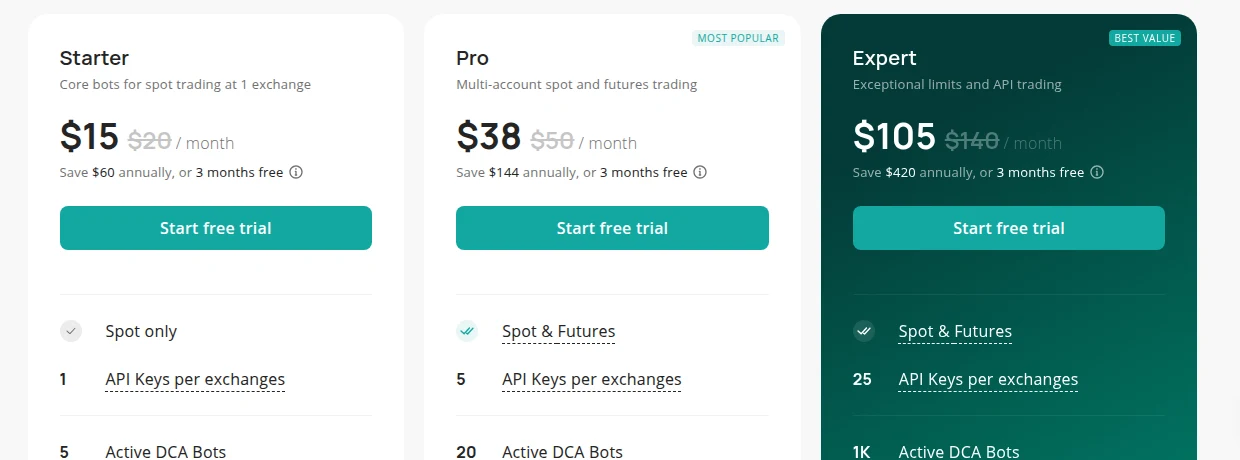
Cloud configurators: 3Commas defined the base-order-plus-safety-ladder UX and still prices it at $15/38/105/mo annual ($20/50/140 monthly) with 5/20/1000 bot limits by plan[3]. Bitsgap ($23-149/mo, 7-day trial), WunderTrading (free tier, $0-100/mo, 7-day trial) and Cryptohopper ($29-129/mo, 3-day trial) cover the same pattern with different marketplace angles. Coinrule bills 0.02% of volume instead of a subscription - cheap at low volume, expensive at scale.
No-key and fee-light: Pionex runs its DCA bot inside the exchange at 0.05% per side[4] - no API keys, no subscription; Binance, OKX, Gate and peers ship equivalent native bots. Fewer knobs than the cloud configurators, dramatically lower total cost of ownership.
It depends on the multiplier. Our simulation (base $100 + 7 safety orders covering -47.7%): flat 1.0x commits $800, moderate 1.5x commits $4,926, aggressive 2.0x commits $25,500 - a 32x spread. The platform is irrelevant; the ladder sizing decides.
A better average entry. After all 8 fills, average entry sits -20.1% under base at 1.0x, -33.3% at 1.5x and -38.6% at 2.0x. The 32x capital buys 18.5 percentage points of entry improvement - and takes the last order alone to 50% of total capital.
As dip-buying ladders, they repair entries; as standalone strategies they carry the same market risk as the asset. On our drawdown replays the 2021-22 cycle (-76.6%) still lost 56-67% of committed capital at every multiplier. No configuration removes directional risk.
For long-horizon accumulation, plain scheduled DCA wins on simplicity, fees and zero config risk - the academic record (Constantinides 1979) already treats DCA as suboptimal versus lump-sum for expected-value maximizers[2]. DCA bots earn their keep on shorter horizons and range trading, where timed extra fills matter.
The bot holds a fully loaded bag with no averaging left - the "holding a bag" critique community traders have made since 2022[6]. On the 2021-22 replay, every multiplier ended the cycle far underwater. Ladder depth is a survival decision, not a profit dial.
Exchange-native (Pionex 0.05% per trade, no subscription[4]) and open source (Freqtrade free[7]) undercut every subscription. Among cloud plans, 3Commas runs $15-105/mo annual[3]; Coinrule bills 0.02% of volume instead. Compute the fee against your real monthly volume before choosing.
They average into it - which lowers the entry but multiplies exposure into falling prices. Our running 2025-26 replay (-53.0% so far) shows 1.0x at -35.2% and 2.0x at -15.6% on position PnL: better percentages on far bigger absolute capital.
Conservative defaults that survive historical BTC drawdowns: first deviation ~2%, price step scale ~1.3-1.4x, volume multiplier 1.0-1.2x, enough orders to cover a drawdown deeper than any you are unwilling to hold through. The [DCA calculator](/tools/dca-safety-order-calculator/) computes coverage from your inputs.
Yes - most run TP cycles (sell the accumulated lot at target, restart). That is where platform differences matter: TP-step vs full-exit handling, trailing TP, and deal-start conditions differ sharply between 3Commas, Bitsgap, WunderTrading and exchange-native bots.
It is the same multiplier question with worse tail risk. Aggressive volume multipliers concentrate capital in the last, deepest orders - exactly where drawdowns hurt most. Our 2.0x curve commits 32x the flat capital for a fraction of the entry benefit.
Yes, but backtest the capital curve, not just returns. Freqtrade, Bitsgap, Cryptohopper, OctoBot and Gunbot all backtest; insist on drawdown-of-capital output, because that is the number that kills DCA ladders.