DCA Bots vs. Plain DCA - Safety Orders and Risk
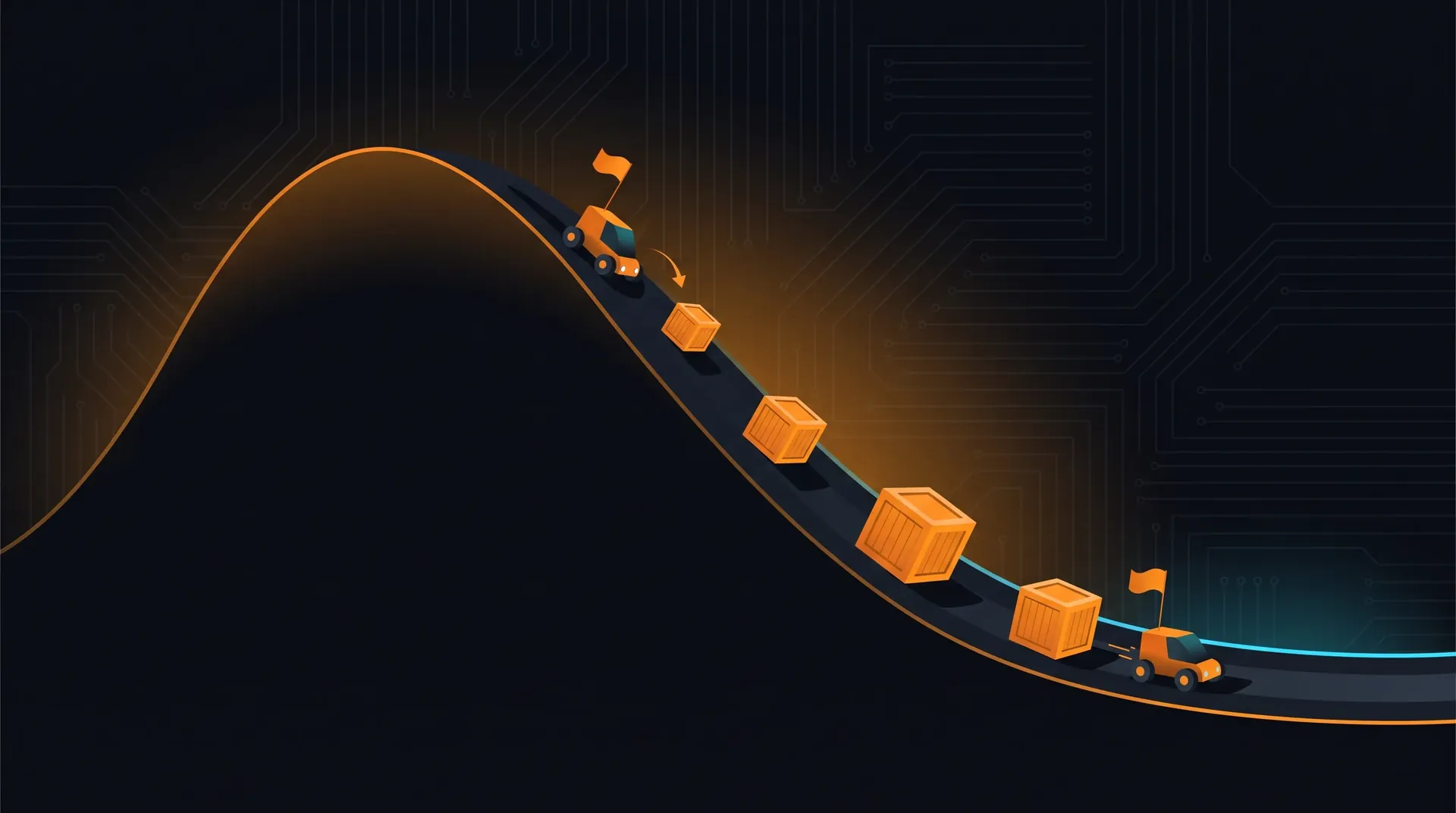
Short answer: A DCA bot automates buying the dip: a base order plus pre-funded safety orders that trigger as price falls, with take-profit calculated on the average entry. Done conservatively it removes timing emotion entirely; done aggressively the martingale sizing turns it into leverage-like risk.
Dollar cost averaging is boring and effective. DCA bots automate it - and optionally add martingale-style position sizing that turns boring into leverage-like risk. This guide separates the two, because the difference between a disciplined accumulation tool and a drawdown machine is entirely in the safety order configuration.
table of contents
What plain DCA actually is
The term comes from Benjamin Graham's 1949 formulation: invest "the same number of dollars each month or each quarter" - which buys more shares when prices are low and fewer when they are high, ending "with a satisfactory overall price for all holdings" [1]. The mechanism is the harmonic mean: buying a fixed amount at varying prices produces a lower average cost per unit than buying a fixed number of units on the same schedule [1].
The definition matters because it is deliberately minimal: two parameters, fixed amount and fixed interval, and nothing else [1]. No triggers, no multipliers, no market timing. That minimalism is the feature - constant decisions are unnecessary, and the strategy survives its operator's emotions.
What a DCA bot adds over the manual version
Automation and optionality:
- Base order - the fixed-schedule buy, identical to plain DCA.
- Safety orders - pre-funded buys that trigger when price deviates downward by a set percentage.
- Take-profit engine - targets calculated on the weighted average entry, closing the whole cycle when hit.
- Volume multipliers - each successive safety order can be larger than the last.
Done at 1.0x multipliers and wide deviation steps, this is a modest mechanical improvement on plain DCA. Done at 2x multipliers and tight steps, it is a different instrument entirely.
The martingale trap
Most DCA bots let safety orders grow by a volume multiplier of 1.2x-2x per level. The arithmetic that makes it attractive: each successive dip buys a larger chunk, so the average entry converges to price quickly, and small bounces close the entire position in profit. Community threads are full of exactly those satisfying round trips [2].
The arithmetic that makes it dangerous: capital consumption grows geometrically with depth. At 2x multipliers, your fourth safety order costs eight times the first; a deep enough fall exhausts the reserve exactly when the position is largest. The bot does not blow up in the way a leveraged trade does - it just leaves you holding a large bag with no dry powder, at the bottom of a range you chose before the fall.
Sizing safety orders conservatively is the whole game, and it is the one parameter set marketers never show you. Run your configuration through the DCA safety order calculator before funding it: it shows the total capital committed at each depth and the price at which your reserve runs out.
When plain DCA wins
For long-horizon accumulation of BTC or ETH, Graham's two-parameter version [1] buys through any drawdown with zero configuration risk, zero subscription cost, and zero martingale exposure. The bot layer earns its keep only when you actively want the dip-buying and cycle-closing mechanics - shorter horizons, range plays, or taking profit on rotation rather than accumulating forever.
Cost compounds the point: cloud DCA platforms charge subscription tiers on top of trading fees [3], while plain DCA costs nothing but the trades. On small accounts the subscription alone can exceed the strategy's edge.
Configuring a DCA bot that survives
- Fixed the capital allocation before touching any multiplier - the total across all safety orders is the real position size.
- Keep multipliers near 1.2x-1.5x; simulate 2x configs in a drawdown before believing them.
- Set deviation steps wide enough that safety orders trigger on trend breaks, not noise.
- Take-profit targets belong to the average entry - recompute them after every filled safety order, which good bots do automatically.
- Prefer assets you would hold anyway; the martingale structure punishes dead-coin DCA hardest.
Live DCA-capable platforms from our database, with their hosting model:
| Bot | Category | Custody | Score |
|---|---|---|---|
| 3Commas | Cloud platform | Your keys (API) | 7.1/10 |
| WunderTrading | Cloud platform | Your keys (API) | 7.4/10 |
| Cryptohopper | Cloud platform | Your keys (API) | 7.4/10 |
| Binance Trading Bots | Exchange-native | Exchange-held | 6.8/10 |
Live values from our database - details, fees and incidents in each review.
For the oscillation counterpart - trading the range instead of averaging into it - see the grid bot guide; for when either approach beats simply holding, the bot vs. hold comparison has the regime-by-regime answer.
FAQ
Are DCA bots profitable?
In oscillating and recovering markets they frequently close profitable cycles - community threads document multi-month runs with positive round trips [2]. In sustained downtrends they accumulate inventory at a loss: the risk is deferred, not removed, and sizing decides survival.
What is a safety order?
A pre-funded buy that triggers when price falls a set percentage below your base entry. More safety orders with smaller multipliers survive deeper drawdowns; fewer, larger ones run out of capital sooner. The safety order calculator shows your exact exposure.
Is bot DCA better than plain DCA?
Not always - and the classic literature is on plain DCA''s side. Benjamin Graham''s original formulation is a two-parameter strategy: fixed amount, fixed interval [1]. Everything a bot adds on top (deviation triggers, multipliers) is optional complexity with optional downside.
How much should safety orders grow per level?
Stay near 1.2x-1.5x per level. At 2x and above, a deep drawdown consumes your reserve capital geometrically - the last few safety orders cost more than all the previous ones combined.
Do DCA bots work in bear markets?
They keep closing small profitable cycles on bounces while accumulating a growing unrealized position on the falls. "Lose less, still lose" is how experienced operators describe DCA bots in sustained downtrends.
Sources
- Wikipedia - Dollar cost averaging (Graham 1949, cost average effect, two-parameter setup) - accessed 2026-09-06
- Reddit - Pionex grid/DCA megathread (community-documented bot results) - accessed 2026-09-03
- 3Commas pricing page (cloud DCA bot subscriptions) - accessed 2026-09-03